
What does it take to prepare the next generation of software developers and cyber security professionals for a world being reshaped by artificial intelligence?
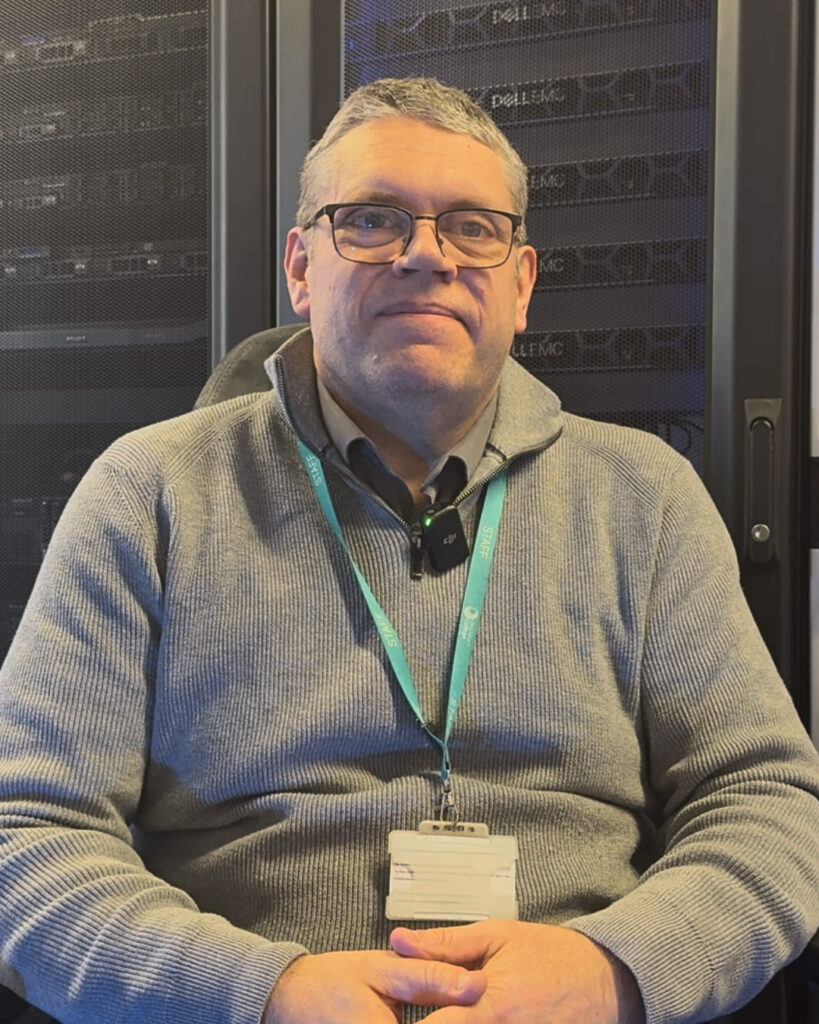
Stuart Gregory, Creative and Digital Curriculum Area Manager at Blackburn College, has a clear answer and he’s already rewriting the curriculum to prove it.
Stuart says: “There’s a preconception out in the world that software developers aren’t needed anymore. But I believe they are needed to develop the artificial intelligence, and every business out there is going to have or want AI in some way, shape or form in the near future.”
This has driven a significant evolution in Blackburn College’s digital offering. Stuart leads the curriculum for the IoT’s Networking & Cyber Security and Software Development & AI degrees, which have both been freshly redeveloped to reflect the rapidly changing demands of the sector.
The BSc (Hons) Software Development and AI course deliberately moves beyond traditional programming. Where previous courses focused on the basics of code, the new curriculum weaves in AI principles and data manipulation from the outset – highlighting that AI is no longer a specialism but a widespread force across industries.
“We’ve incorporated AI with software development going forward, with the hope that AI jobs will be filled by our students,” Stuart says.
There is a growing amount of graduate-level tech roles advertised that include some AI element, so by embedding it throughout the degree rather than treating it as a bolt-on module, Blackburn College aims to give graduates a competitive advantage.
The BSc (Hons) Networking and Cyber Security degree takes an equally hands-on philosophy.
Stuart is clear that you cannot teach security without first understanding networks, and from that foundation, learners progress into the principles of the CIA triad, the Parkerian Hexad, and real penetration testing using live tools – all within the college’s own sandbox network, where vulnerable machines can be created, attacked and defended without any risk to real systems.
One of the more forward-thinking elements of the adapted curriculum has been a focus on legacy equipment – the older hardware and systems that organisations cannot always afford to replace, but which present significant vulnerabilities. Learners are challenged to find creative solutions, exploring how to wrap ageing infrastructure in updated firewall configurations and thinking laterally about protection rather than replacement.
Technical excellence alone is not enough. Many students are more comfortable behind a screen than in a room full of people, so the response at Blackburn College has been to embed professional skills directly into the curriculum.
The project management module sees students pitch ideas to external visitors, collaborate across teams using tools like Microsoft Teams and Discord, and produce formal written reports.
Beyond the classroom, students are encouraged to attend events such as Lancashire Tech Talks, where they meet working professionals and begin to find their confidence.
The proof of any curriculum lies in what graduates do next, and Blackburn College’s alumni are already making their mark.
One graduate built and posted simulated networks on LinkedIn using Packet Tracer skills learned on the course, which employers noticed and secured him a role on the strength of those posts alone. Others are working as digital forensic analysts in Scotland’s financial sector, or in support roles where cyber awareness is a daily necessity.
The breadth of destinations reflects the intentionally wide-ranging nature of the courses, as the aim is to equip graduates for a variety of roles rather than train narrowly for a single job title.
“Some of our students who are currently working in industry have told us they’ve learned more from us than they need to for some of their jobs,” says Stuart.
“We try to cover as much technical ground as possible so that when our graduates go out into the real world, they are work ready.”
These courses form part of the broader offer from the Lancashire & Cumbria Institute of Technology, and for Stuart, that alignment reflects a genuine belief about how technical education must work.
“There’s always going to be a skills gap because the technology moves so quickly. What we need to empower our students to do is go off and keep learning – we never stop in our discipline.”
And the pace is only quickening. “AI is bleeding into everything and our students will be ready for it,” he adds.
For prospective learners across Lancashire and Cumbria, Blackburn College has no intention of being left behind.